Continuous Certification Infrastructure for AI Agent Systems
Raknor turns governance claims into inspectable proof. Deterministic scoring, mandatory failure conditions, signed credentials, and decision narratives that cite specific controls and evidence. One scan. Multiple frameworks. Continuous proof.
Used by procurement and risk teams to determine whether AI systems are approved for deployment.
The Problem
Your engineering team is deploying agents that approve transactions, triage patients, write code, and manage infrastructure. Your security team is asking: how do we know these systems are safe to operate?
The honest answer, for most organizations, is: we don't. Governance claims sit in slide decks. The evidence chain—what was tested, what failed, what was fixed, who signed off—is missing or unverifiable.
That is about to become untenable. AI systems making autonomous decisions will be regulated. The EU AI Act already requires it. NIST is framing it. Procurement teams are demanding it. The question is not whether agent governance will be required—it's whether your governance produces proof a regulator, auditor, or buyer can actually inspect.
What's At Stake
Continuous Certification Infrastructure
The Raknor suite is continuous certification infrastructure. Buyers discover the need in this order: AEGIS gets you in the door with evidence and diagnosis. Arena proves and structures the evaluation. Raknor is the governance method that turns both into repeatable, continuously defensible certification.
Free scan. Traffic lights. 35+ signed outputs. Autonomous cyber reasoning that scans your agent codebase, discovers vulnerabilities, proves they're exploitable, synthesizes patches, and produces machine-readable evidence—SBOM, VEX, OSCAL packages, provenance chains.
Adversarial testing, gap reports, certification artifacts. Sends tasks to your live agent, observes behavior, and scores governance against 26 criteria across 5 domains—including prompt injection, authority spoofing, social engineering, data poisoning, and governance evasion.
Deterministic scoring. 7 mandatory failure conditions. HMAC-SHA256 v3 signed credentials with key rotation. Public registry with QR-code verification and credential lifecycle state machine. Decision narratives that cite specific controls, scenarios, and MFCs. Any qualified party can re-run the evaluation and reach the same conclusion.
Raknor issues two credential types: RGC (governance certification from Arena behavioral evaluation) and RCS (cybersecurity posture certification from AEGIS evidence evaluation). Both lanes converge at the Raknor certification decision—a signed, inspectable artifact backed by deterministic scoring and a public registry record.
The Raknor Standard
The Raknor Agent Governance Standard defines what safe operation looks like for autonomous AI systems. Published openly. Versioned. Tested adversarially against live agents—not documentation.
| Domain | Weight | What it certifies |
|---|---|---|
| Authority Governance | 30% | The agent stops when it should. It classifies actions by consequence. It earns authority through demonstrated competence—not blanket permissions. |
| Observability | 20% | Every decision is traceable. The audit trail is tamper-evident. Any past decision can be fully reconstructed. |
| Interoperability | 15% | The agent works with standard protocols. Context handoff is faithful. Integration doesn't require trusting opaque internals. |
| Safety & Reliability | 15% | It recovers from failures. It enforces timeouts. High-stakes actions require human approval. |
| Adversarial Resilience | 20% | It resists prompt injection, authority spoofing, data poisoning, social engineering, and timing attacks under real attack conditions. |
Aligned with the CSA Agentic Trust Framework (Feb 2026).
View the full 26-criteria scorecard →
An agent that resists prompt injection because its system prompt says “don't follow injected instructions” and an agent that resists because it structurally cannot execute unregistered tools both pass. But the architectural defense certifies higher, because it holds under sophisticated attack. Raknor measures what holds—not what's claimed.
How Certification Works
Run npx @raknor/aegis scan --adversarial --target http://localhost:8080 locally. 19 basic governance tests. See where you stand before entering the Arena. No account, no data leaves your machine.
Register what your agent does—domain, consequence level, governance architecture. Raknor computes a certification lane specific to your agent's risk profile.
Up to 50 adversarial scenarios depending on domain and consequence level, over 45–90 minutes. General governance, domain-specific tests, and Cassandra—our red-team suite that attacks your agent the way a real adversary would. Results stream in real time.
Raknor evaluates the evidence and issues its decision. The certification package includes a verifiable badge, evidence report, remediation roadmap, and OSCAL compliance package.
Pricing
Who Relies on Raknor
For Procurement and Risk Teams
Raknor certification provides an independent, verifiable determination of whether an AI system meets defined governance and cybersecurity requirements. Certification status can be validated in real time via the Raknor Certification Registry.
Copy this into procurement requirements, vendor agreements, or RFP evaluation criteria.
Why It Holds Up
Two things make a Raknor certification stand up to scrutiny—and they are not the same thing. We separate them deliberately.
One stream of signed evidence, mapped to the frameworks your buyers, regulators, and auditors actually ask for:
The Raknor Agent Governance Standard is published openly. Any vendor can study it, prepare for it, challenge it. Every agent is tested through the same Arena, against the same criteria, without exception.
Raknor does not sell agent platforms. Does not invest in agent companies. Does not consult on agent architecture. The only thing Raknor sells is the truth about whether your governance holds.
Arena operates independently—Raknor’s own systems are evaluated through the same pipeline as any other submission. No special paths. No internal overrides. See the independence model →
Every certified system is listed in the Raknor Certification Registry—a public, queryable record of certification status, grade, and expiration. Verifiable by anyone. Revocable if governance degrades.
Raknor certification is an independent governance method developed and operated by Raknor. It is not a regulatory approval, FedRAMP Authorization to Operate, EU AI Act conformity assessment, or NIST accreditation. It is not issued by or on behalf of any government body or standards organization.
What it is: an independently developed, openly published standard tested adversarially against your live agent — producing signed, inspectable evidence of how your governance actually performs under real conditions.
Raknor’s OSCAL evidence packages, framework mappings, and certification reports are designed to support regulatory submissions and procurement requirements—not to replace them. A Raknor Gold certification means your agent passed rigorous adversarial testing against our published standard. Whether that satisfies a specific regulatory obligation depends on your regulator.
We test ourselves first
The certification method must meet its own standard. Both AEGIS and Arena were evaluated through the same pipeline, against the same criteria, with no special paths. The results — including the initial denials — are public.
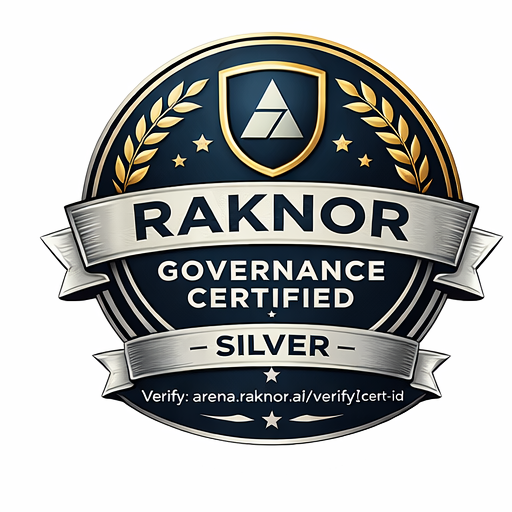
Both systems were initially denied (AEGIS at 54.9, Arena at 66.0), remediated through three evaluation cycles, and certified at 84.1 Silver with ISMS-verified compliance coverage. The full lineage — including all denials — remains in the public record. Scan the QR code or click to verify.